How a Patek Stays Secure While It Backs a Loan
When a Patek Philippe is placed against a short-term loan, the natural worry is not the paperwork but the object itself. Where does it go, who touches it, and does it come back exactly as it left? The honest answer is that a well-run collateral desk treats the piece less like merchandise and more like a museum deposit.
What actually happens to the watch when it arrives
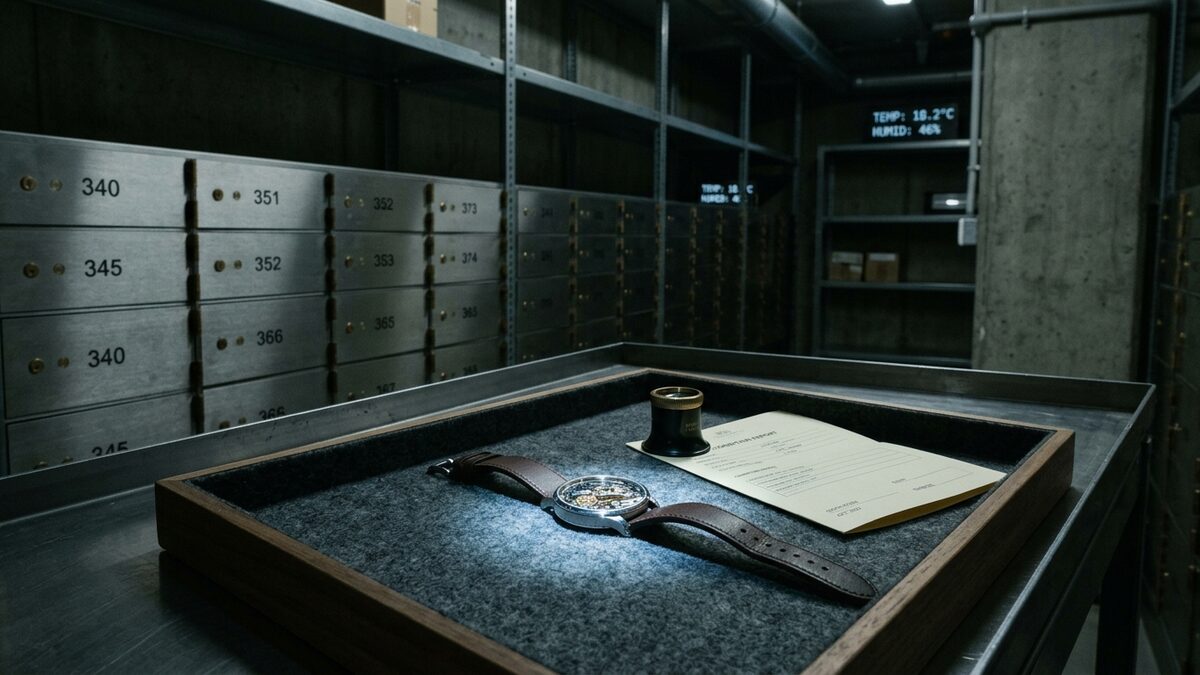
The process begins before the loan figure is agreed. A specialist examines the watch under a loupe and records its reference, movement, case, dial, and any service history the owner can supply. Every mark is noted, from a hairline on the clasp to the faint patina on a tritium dial, because the condition report is the document that protects both sides. It establishes the state of the object on the day it was handed over, and it is what the return is measured against.
High-resolution photography follows. The caseback, the lug profile, the crown, and the movement where accessible are all captured, so that identity is never in question. For a Patek, this often includes the reference and case numbers that the manufacture recorded at production, along with the Extract from the Archives if the owner has one. That paper trail travels with the file, not with the watch, and it is stored separately from the piece itself.
There is a reason collateral desks pay close attention to Patek Philippe in particular. The manufacture's records make identity unusually easy to confirm, its pieces hold value in a way that makes them predictable to insure, and its owners tend to know exactly what they are holding. All of that makes the intake cleaner and the storage decision simpler, because a piece whose provenance is documented is a piece that can be protected without guesswork.
Only after the record is complete does the watch move into storage. It is not left on a desk or displayed. It goes into a sealed, numbered container that links back to the loan file, and from that moment its location is logged rather than assumed.
The storage itself is the part most owners want to understand. Pieces are held in a bonded vault, the same category of facility used for bullion and fine art, with graded doors, redundant alarms, and monitored access. Temperature and humidity are kept stable, which matters for a mechanical movement and matters even more for older lacquer dials and vintage straps. A watch left in a warm safe for months can suffer; a watch held in controlled conditions simply waits.
For pieces on leather, the strap is a particular concern. A vintage strap can dry and crack in poor storage, so straps are supported rather than left under tension, and the more valuable the original strap, the more carefully it is kept. Bracelets are cleaned of nothing and altered in no way; a watch that arrives with honest wear is meant to leave with the same honest wear, not a polish nobody asked for.
The owner does not leave empty-handed either. A copy of the condition report, the photographs, and the loan terms is provided so that both parties hold the same record. If a dispute over condition ever arose, it would be settled by that shared document rather than by memory, which is precisely why the intake is done slowly and in detail rather than rushed to release funds.
Insurance, custody, and the day the loan is repaid
From intake to return, the watch sits under a specie insurance policy written for high-value portable objects. The cover reflects the agreed value of the piece, not the size of the loan, so the object is protected for what it is worth rather than what was lent against it. Owners are entitled to ask how that value was set and to see that the cover is in force for the full term.
Chain of custody is the quiet discipline behind all of this. Each time the container is moved, checked, or audited, the action is recorded against the file and against the individual who performed it. Nothing is handled casually and nothing moves without a reason that appears in the log. This is why a serious desk can tell an owner, on any given day, precisely where the piece is and when it was last verified.
It is worth saying what does not happen. The watch is not worn. It is not lent out, photographed for marketing, or shown to prospective buyers. A collateral loan is a loan, not a consignment, and the object is held in trust for the duration rather than offered to anyone. That distinction is the whole point of using a specialist rather than a pawn counter.
Owners can usually stay in contact through the term. A reputable desk will confirm in writing that the piece is held and insured, and will respond to a request for an update on its status. What a desk will not do is move the object for a casual viewing, because every movement is a risk and the safest place for the watch is exactly where it was logged.
When the loan is repaid, the return runs in reverse. The container is retrieved against the file, the watch is checked against the original condition report and photographs, and the owner confirms the match before signing. The Extract, the box, and any papers that came in are reunited with the piece. In practice the watch comes back in the same state it left, which is the entire measure of whether the arrangement worked.
None of this removes the seriousness of borrowing against something you care about. A loan carries a cost, a term, and a consequence if it is not met, and those figures deserve as much attention as the storage arrangements. But the fear that a treasured Patek will be treated as stock on a shelf is, at a properly run desk, misplaced. The object is documented, sealed, insured, and tracked, and the ordinary expectation is that it waits quietly in the dark until it is time to go home.