Borrowing Against an Annual Calendar Patek
An annual calendar occupies a particular place in Patek Philippe's catalogue: more mechanically involved than a time-only Calatrava, less rarefied than a perpetual calendar, and valued somewhere between the two when the piece is offered as collateral for a short-term loan.
What the annual calendar complication contributes to the appraisal
An annual calendar tracks the length of each month and advances the date correctly through every month except February, requiring only one manual correction a year. That mechanism sits a tier below the perpetual calendar, which handles leap years unaided, and a tier above the simple date. For an appraiser, the complication matters less as a bragging point than as a component of what the watch would fetch today on the secondary market.
LoanYourPatek quotes against that real exit rather than a retail list price, which is why Patek carries the highest loan-to-value of any brand in its book, up to 65 percent. The number attached to an annual calendar is a function of its reference, its metal, and the condition it arrives in, not of the complication in isolation. A well-kept example in a desirable configuration is priced against the comparable sales that define its wholesale floor, and that floor is where the loan range begins.
It helps to understand how the brand groups these pieces. On the LoanYourPatek book, annual calendar and world-time references are listed together, including the 5905P, alongside references such as the 5230G, 5170 and 5172. Each has its own market, and the spreads between them are known to the lender network rather than guessed at. That familiarity is the point: a quote is tied to what the watch would realistically sell for now, so comparing offers only makes sense on the same day, because the underlying wholesale numbers move with recent results.
Where an annual calendar differs from a straightforward Nautilus or Aquanaut is in how much the mechanism and its upkeep weigh on the figure. A complicated movement is more expensive to service and more sensitive to past interference. That brings the condition of the caliber, not just the case and dial, into the center of the appraisal.
Why movement condition and service history matter, and what to prepare
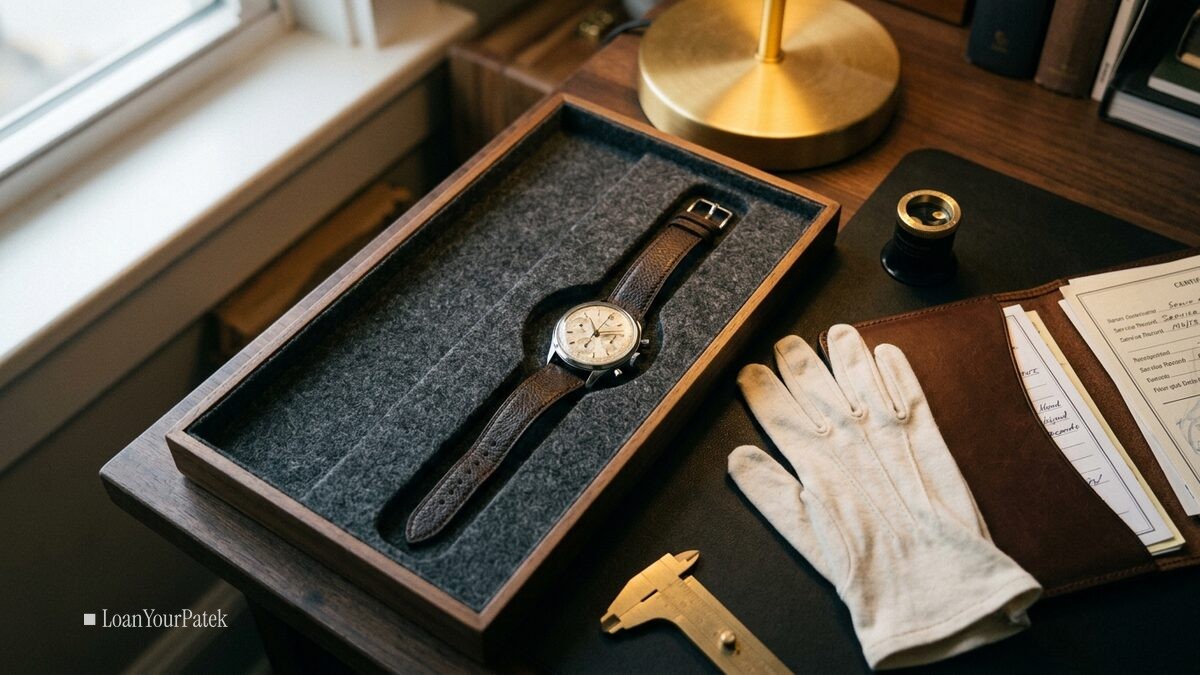
On complicated Patek references, authenticity and service paperwork are treated as critical rather than optional. A documented service history tells the appraiser that the calendar mechanism has been maintained by competent hands, that the movement is running as it should, and that the parts inside are the ones that belong there. Where it is available, an Extract from the Archives requested from Patek Philippe adds a further layer of confidence about the original specification of the watch.
Condition and originality are judged in person. A replaced part or a heavily polished case can lower what a lender is able to offer, because both affect where the piece lands within its range. For an annual calendar, that scrutiny extends to the movement: non-original components inside a complicated caliber carry more weight than they would on a time-only piece. None of this disqualifies a watch that has been serviced or lightly refinished; it simply means the appraiser accounts for it, and that an honest picture from the outset leads to a cleaner process.
Before borrowing against the piece, an owner can do a few practical things. Gather the box and papers, which support authenticity and help the value. Locate any service records, and note when the watch was last attended to. If an Archive Extract exists or can be requested, mention it early. When submitting photos, include clear images of the front, back and sides, along with the movement and case back where possible, and the reference and any date code.
The mechanics of the loan itself are straightforward. The final figure is set at in-person appraisal, which for this network takes place at a California licensed-lender location.
An annual calendar rewards an owner who arrives prepared. The complication is part of what gives the watch its value, but it is the movement's condition, its service history, and the documentation around it that decide where inside the range a given example sits. Assemble that evidence before the conversation begins, and the appraisal reflects the watch at its best.