Aftermarket Parts and Your Patek Loan Offer
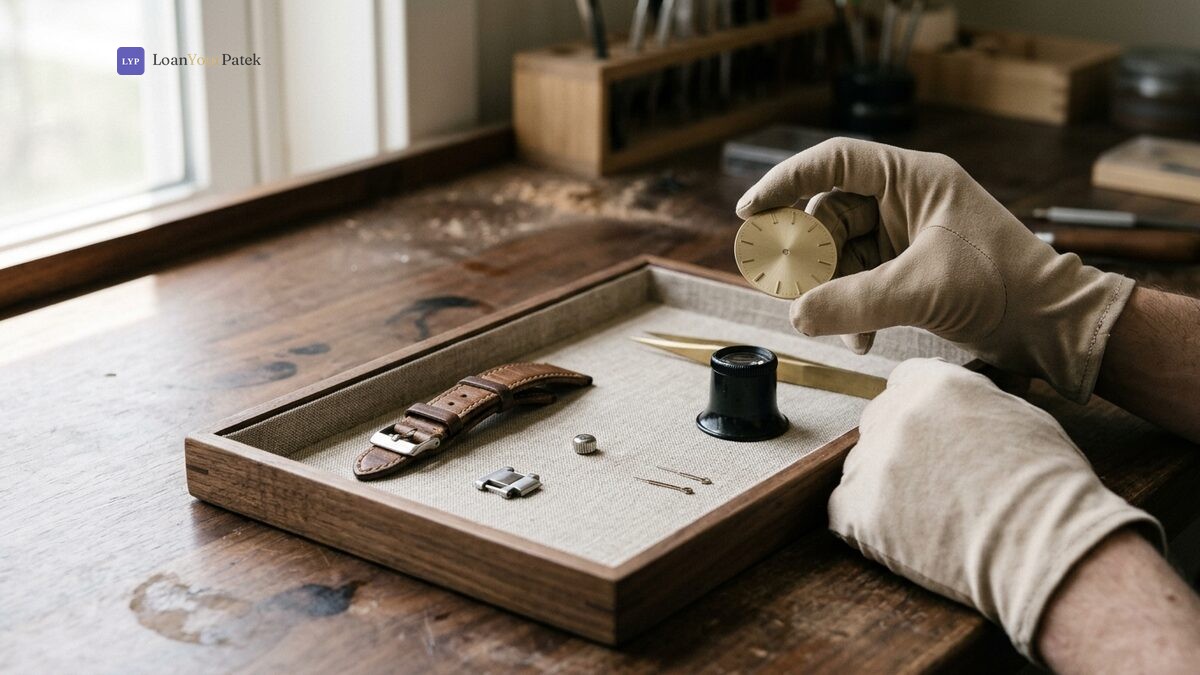
A lender advancing against a Patek Philippe is valuing the watch as it left the manufacture, adjusted for what time and ownership have done to it. Aftermarket parts complicate that picture, and they are worth understanding before you ask for a loan offer.
Loan offers against a Patek Philippe are tied to what the watch would fetch in the secondary market today, not to a retail list price. That framing explains most of what follows. An appraiser is not only asking whether the watch looks right on the wrist. The question is how a buyer would see it, and originality is a large part of that view. Condition and originality are both judged at in-person appraisal, and non-original parts or heavy polishing may lower what can be offered against the watch. Because the loan is set as a share of that value, up to 65% LTV on the strongest references, anything that moves the value moves the ceiling with it.
Authentication comes before valuation. The lender's team has to be satisfied that the watch is what the reference says it is, and parts that do not match can prompt closer questions even when the case and movement are genuine. Box and papers support authenticity. For older or more complicated pieces, a documented service history and, where available, an Extract from the Archives requested from Patek Philippe add confidence. On perpetual calendars especially, authenticity and service paperwork are critical, so a modified example in that tier draws particular attention.
It helps to think in classes of modification, because each raises a slightly different question. None of them comes with a fixed deduction. The effect on an offer is decided at appraisal, and the direction is more reliable than the size.
- Aftermarket diamond settings. A bezel, case or dial set with stones after the fact is a change to the object itself, and a hard one to reverse. A lender has to decide whether the work adds anything a buyer would want or departs from the reference as made. Expect that judgment to be made at appraisal, and expect it to lean cautious.
- Replaced or refinished dials. The dial is the first thing anyone inspects. A dial that has aged naturally is a different matter from one that has been replaced or refinished, and the second is treated as a non-original part. Documentation showing what was done, and by whom, helps the appraiser place it.
- Non-factory bracelets and straps. Aftermarket straps and buckles for Patek Philippe watches are sold widely, so an appraiser will look at whether the one on the watch is the factory piece. This is often the most modest of the five, because the original can sometimes simply be refitted, provided you still have it.
- Swapped crowns or hands. These are small parts, but they are checked against the reference. A crown or set of hands that does not match can prompt wider questions about what else has been changed, which is why a record of factory replacement matters.
- Heavy case polishing. Nothing is added, but material is removed, and it cannot be put back. The lender's own FAQ names heavy polishing alongside non-original parts as something that may lower what can be offered.
Part of the reason originality carries weight is that Patek values depend on specific variants. Dress watches such as the Calatrava can carry collector premiums on full-stainless and platinum variants, and a premium only holds when the watch is the variant it claims to be. An aftermarket part blurs that claim, and the lender is the one left holding the collateral if the claim does not stand up.
Documentation is the most practical thing an owner can bring. A service record that shows a replacement part came from the manufacturer reads very differently from a replacement with no paper trail. The useful items are short:
- Service records that list parts replaced, ideally noting factory components.
- Any original components you kept, such as the earlier bracelet, strap or buckle.
- Box and papers, which support authenticity and help value.
- An Extract from the Archives, for older or complicated pieces where one is available.
Then there is disclosure. Appraisal is in person, by appointment, and a trained eye will find what has been changed. Mentioning a non-original part at the start means the preliminary range you receive is built on the watch as it actually is, rather than on a flattering assumption that gives way at the bench. A preliminary range is only a starting point; the final figure is set by the licensed lender at appraisal. Market conditions also move, since a quote is tied to what the watch would fetch now, so a surprise at inspection stacks on top of ordinary movement.
When you write in, send four to six photos, the reference number and whatever documentation you have, and say plainly which parts are not original, with a photograph of each. If you are unsure, call it out anyway and let the appraiser decide. LoanYourPatek connects owners with licensed lenders and does not set terms; figures on the site are general guidance, not loan offers, and no amount can be stated in advance of appraisal.